
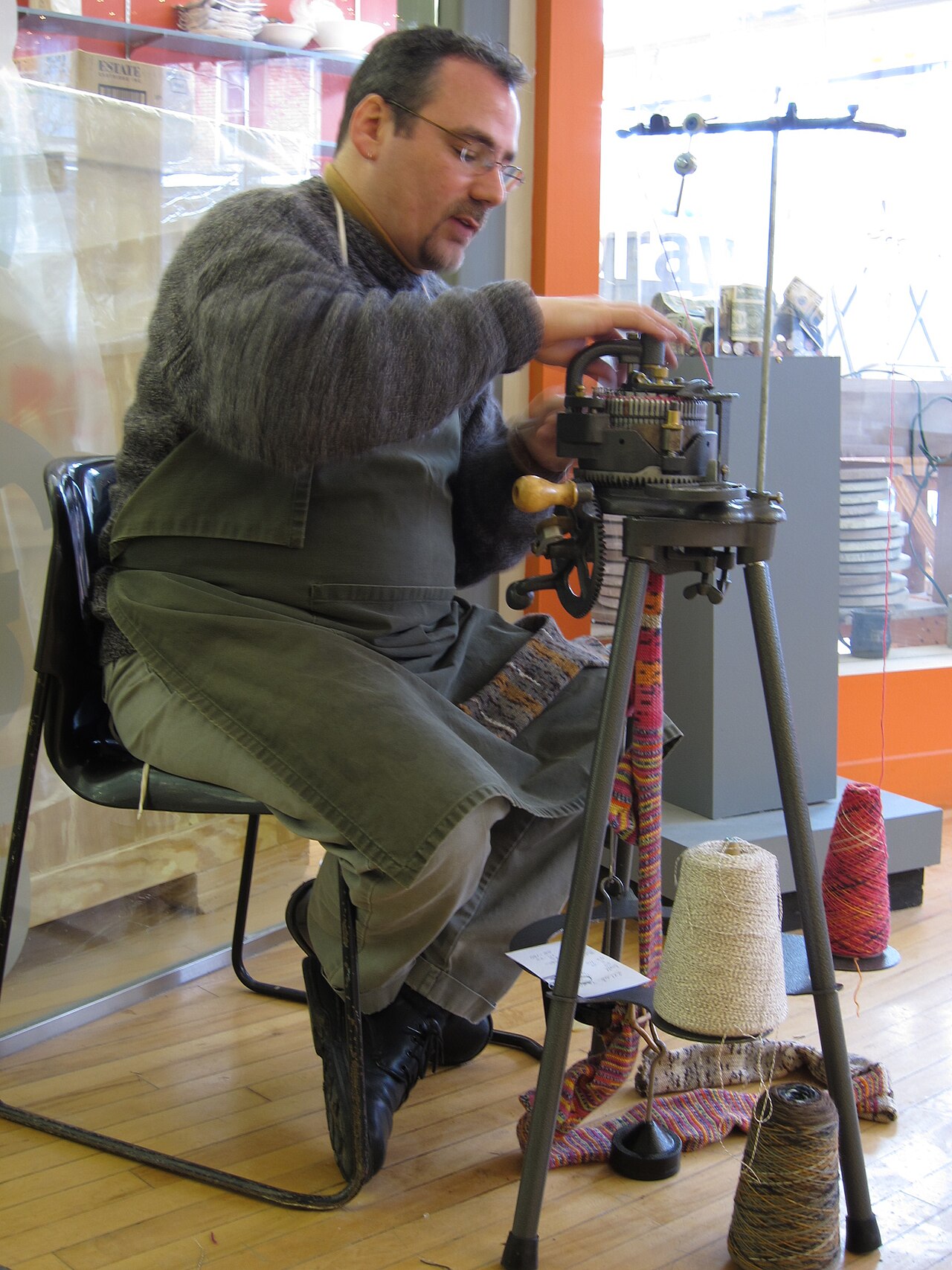
Two fabrics can carry the same fibre label and behave differently when stretched, wetted or worn. The label names an important ingredient, but it does not describe the complete material. A knit also has a loop arrangement, yarn construction, density, finishing history and direction. Keeping those features separate makes a comparison more useful than declaring one fibre universally superior.
For a machinery or materials reader, this is a familiar problem: several inputs contribute to an output. The first task is to identify the variables before deciding which one explains the result.
Start with the actual comparison
Write one sentence describing the question. For example, do two stitch structures made from the same yarn respond differently to a specified pulling test? That question is narrower than asking which fabric is best. It names a change and an outcome that can be observed.
A second question might compare two yarn materials knitted into a similar structure. Both are worthwhile, but they require different specimens. If fibre, yarn thickness and stitch arrangement change together, the result belongs to the combined fabric construction. It cannot confidently be assigned to the fibre alone.
Separate the levels of construction
Fibre describes the material in the yarn. Yarn construction adds features such as how fibres or filaments are assembled. Knitting arranges that yarn into interlocking loops. Finishing can further alter the fabric through treatments applied after its initial construction.
These levels interact. A loop cannot behave independently of its yarn, and a finishing treatment acts on an already structured material. A useful specification therefore records all the levels rather than treating them as competing explanations.
| Level | Example information to record | Common confusion |
|---|---|---|
| Fibre | Composition and blend proportions | Assuming the composition describes the whole fabric |
| Yarn | Construction and linear density | Comparing different yarns as if only fibre changed |
| Knit | Stitch pattern and loop arrangement | Ignoring direction or structure |
| Finish | Known treatment and washing history | Attributing a surface effect to the underlying fibre |
Why stitch structure deserves its own line
The primary study Programming mechanics in knitted materials, stitch by stitch investigates how knit architecture contributes to mechanical behaviour. It provides a research example of why stitches are functional structural elements, rather than merely a visual pattern.
For a simple comparison, sketch or photograph the repeat and name the structure. Record which face is being viewed. If a sample has a complex repeat, a small close-up can be more informative than an overall photograph of a garment. The aim is to make the compared construction identifiable.
Mark the direction before cutting
Knitted materials have course and wale directions associated with rows and columns of loops. A specimen tested in one direction should not be silently compared with another tested across it. The orientation is part of the measurement, just as the direction of a load matters in other engineered structures.
Before separating samples, mark their orientation on a diagram and use consistent specimen labels. If the original direction is unknown, record that uncertainty. Guessing afterward from a distorted cut edge can introduce an avoidable difference into the comparison.
Make a small comparison matrix
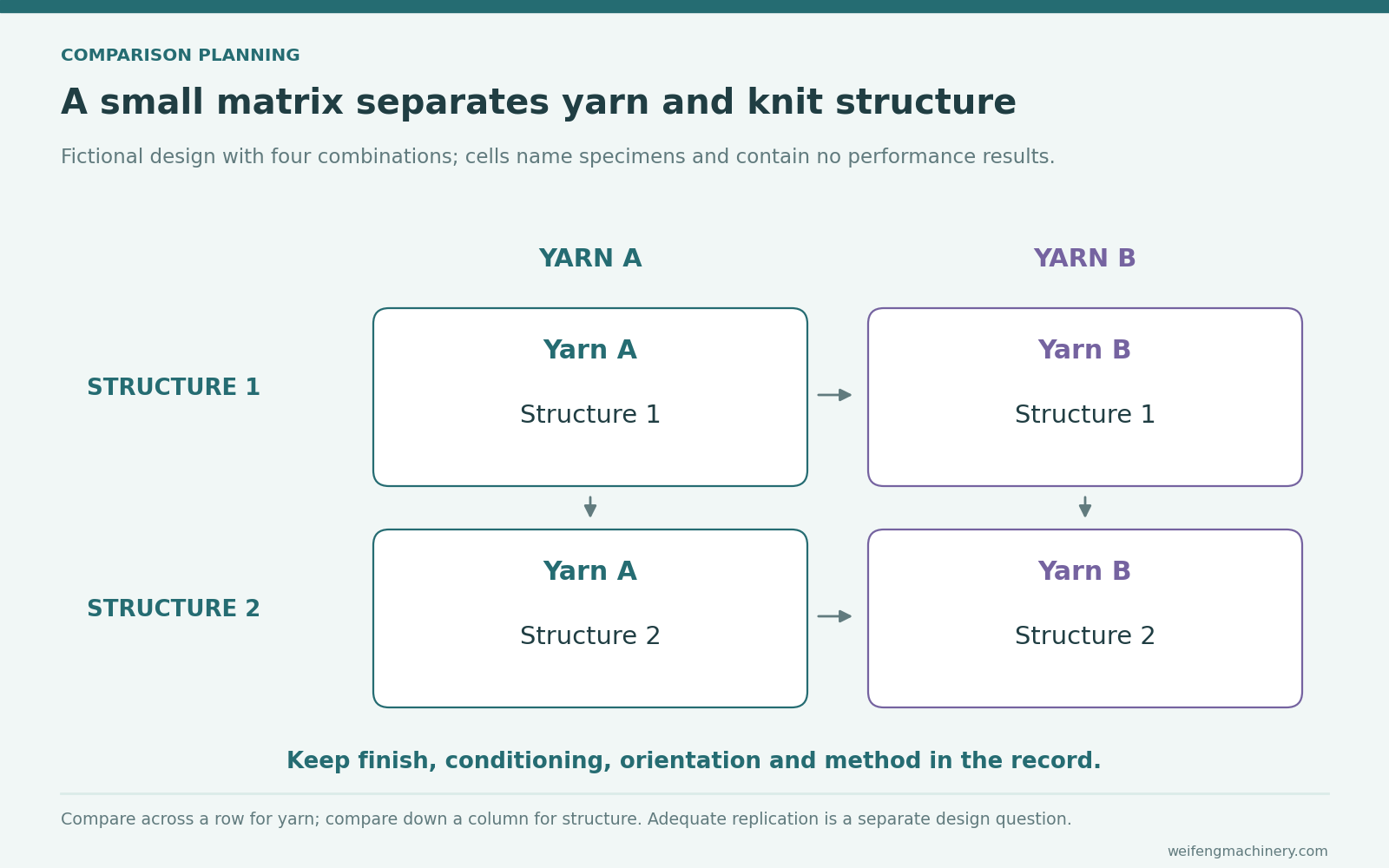
Consider a fictional planning example with two yarn types and two knit structures. Four combinations allow the effect of structure to be examined within each yarn type. The matrix also makes missing combinations obvious. Testing only yarn A in structure one and yarn B in structure two leaves both factors entangled.
This planning device does not replace a recognised test method or a statistical design. It helps identify what the samples actually permit you to conclude. Add repeat specimens when required by the chosen method, and keep a record of which production piece each one came from.
Measure the outcome you intend to discuss
Stretch under a defined load, recovery after unloading, thickness and resistance to damage are different outcomes. A material that changes length easily is not automatically weak, comfortable or unsuitable. Each description needs its own measurement and intended use.
The primary study on fibre types and fabric structures in weft-knitted fabrics examines several material combinations. Its value for a reader is the attention to both fibre and structure. Results from the tested constructions should remain attached to those constructions when they are summarized.
Keep specimen history visible
A new sample, a washed sample and a repeatedly stretched sample may represent different states of a material. Record conditioning, laundering and previous testing when they are relevant. Otherwise a before-and-after change can accidentally become a comparison between two supposed material types.
Specimen history also affects repeat work. If one sample is tested several times, its later response may reflect the earlier tests. Distinguish repeated measurements on one piece from measurements on separately prepared pieces. They answer different questions about consistency.
Write a result that fits the evidence
A useful result names the two constructions, the direction, the method and the observed difference. For example, it might say that one specified knit extended further under the chosen loading conditions. That wording is more transferable than calling the material more advanced or better for everyone.
Keep practical selection separate from measurement. A workwear panel, a sock cuff and a decorative fabric may need different balances of properties. Deciding which balance matters is a design choice; measuring the properties is an evidence-gathering task.
Keep length changes attached to their baseline
In a fictional comparison, a marked length of 10 centimetres becomes 13 centimetres in one specimen and 11 centimetres in another under the same defined condition. The changes are three and one centimetres, or 30 and 10 percent of the starting length. These are illustrative numbers, not test results for a named fabric.
The baseline makes the arithmetic interpretable. A three-centimetre change from a different starting length would represent a different percentage. Record the original gauge length and test direction with the result. Neither percentage, on its own, establishes recovery after unloading or suitability for a garment.
Use the same discipline for protein materials
This approach becomes especially useful when the fibre itself is a protein, as in wool or silk. Molecular composition adds another level of structure, but it does not erase the yarn, knit or finish. A compelling molecular explanation still has to connect with the material and test actually used.
Start with an identifiable specimen, change a clearly named factor and report a clearly named outcome. That sequence creates a reliable bridge from ordinary textile comparisons to more specialised questions about protein chains, peptide sequences and functional surfaces.